Your CRI results came back. There's a North African slice you weren't expecting. Or a Southern European ancestor that doesn't match your family tree.
The Mediterranean world spent roughly 3,000 years as the most intensely connected trading zone on the planet. Greeks, Egyptians, and dozens of other peoples moved across it for commerce, conquest, and travel. Along with their goods, they also brought their genes.
What you're seeing in your results is that history.
The Mediterranean Sea and Nile River "Highways"
It's easy to think of rivers and seas as borders dividing different cultures. However, it's equally true to see them as transportation routes, connecting people.
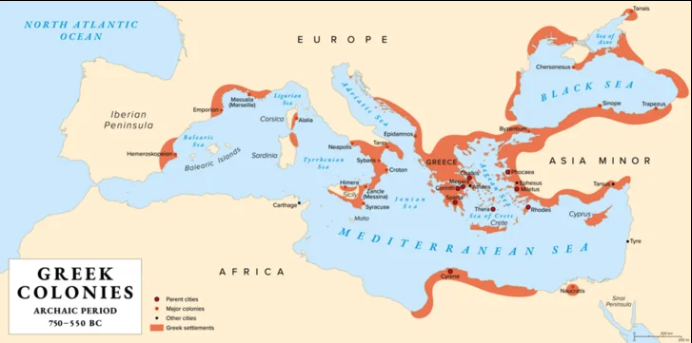
Greek colonists extensively used the Mediterranean Sea and Nile River to reach faraway places. By 600 BCE, Greeks had established settlements across what are now France, Italy, Turkey, Libya, and Ukraine.
A 2025 study analyzing ancient DNA from Phoenician cultural sites described the Mediterranean Sea as "a big, interconnected web of people and ideas — a lot more diverse and a lot more complicated" than anyone previously appreciated.
Southern Europe, North Africa, and the Middle East were always an interconnected web.
"Greek DNA" Reaches Further East, And a Little South
By the time the Parthenon was built, "Greek" DNA was already a mixture of ethnicities.
A 2021 study sequenced ancient DNA from Minoan, Cycladic, and Mycenaean individuals — the three major Bronze Age civilizations near the Aegean Sea.
They found very little mixing in the early Bronze Age; Aegeans had been farming the same area for millennia.
Then, starting around 2,600 BCE, individuals from northern Greece showed approximately 50% ancestry from what is now the Ukrainian and Russian steppes. Steppe herders swept into Europe in a massive migration wave.
As for modern Greeks?
Greeks still share a striking genetic continuity with ancient Mycenaeans — meaning their main ancestors had been there since the Bronze Age.
After that, Greeks show the highest Near Eastern sharing of any European population, according to one study. That reflects thousands of years of Aegean trade connections running east toward the Levant, Egypt, and Mesopotamia.
The same study found modern Greeks showed approximately 6% North African ancestry, and just 1% sub-Saharan African ancestry.
For comparison, this is meaningfully above northern Europeans, who typically show around 4%. But it's far below Spanish, Portuguese, and Italian populations, who showed 9–14% North African ancestry.
Would an African American or Continental African Find Greek Ancestry in Their DNA?
Let's flip the previous question around. What might cause an African American to find Greek ancestry in their DNA?
Multiple large studies of African American DNA converge on the same finding. The average African American genome is approximately 73% African, 24% European, and less than 1% Native American.
That European ancestry is overwhelmingly traceable to slavery. European ancestry in early African Americans is mainly from Britain and Ireland, predominantly on the paternal side — reflecting the documented sexual exploitation of enslaved women by their enslavers.
Y-chromosome DNA traces the direct paternal line, which is how the story can be told so directly. While not all ancestry tests analyze Y-DNA, CRI does, allowing you to explore your father's history across millennia.
As for Greek ancestry specifically? For most African Americans, it's unlikely to appear as a labeled result, since Greek colonizers in the Americas were rare.
Southern European ancestry, if present, would likely come from a recent ancestor.
For continental Africans — particularly Egyptians and Northeast Africans — the picture is different. Ancient Egyptians were most closely related to Southern Europeans and Near Easterners than to Sub-Saharan Africans.
The Ptolemaic dynasty ruled Egypt for 275 years. Greek settlers, soldiers, merchants, and administrators lived throughout Egypt during that period. An Egyptian seeing "Southern European" ancestry on a CRI test may be looking at genuine ancient Greek signal.
Cleopatra: The Greek Queen of Africa
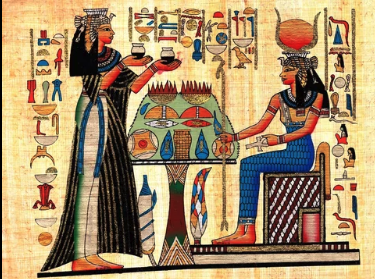
Cleopatra VII has famously raised questions about Greek and African genetic mixing.
She ruled Egypt. She spoke Egyptian. She was worshipped as a goddess of the Nile. And yet...
Cleopatra was a descendant of Ptolemy I Soter — a general who seized control of Egypt after Alexander the Great's death in 323 BCE. The Ptolemaic dynasty practiced sibling marriage for generations specifically to preserve their Macedonian bloodline. So it's no surprise that scholarly consensus places Cleopatra as mainly Macedonian Greek, with some Iranian ancestry.
The mystery is her mother. Cleopatra's maternal lineage is poorly documented. The fact that Cleopatra was the only Ptolemaic ruler in centuries to learn the Egyptian language suggests she had a close connection to an Egyptian speaker, possibly her mother.
A controversy appeared when archaeologists claimed to have found Cleopatra's sister, Arsinoe IV. Skeletal remains found in Ephesus showed a possible sub-Saharan African maternal lineage through mitochondrial DNA. However, a 2025 study re-examined the Ephesus skeleton and determined it belonged to a male, undermining the identification as a member of Cleopatra's family.
Your mitochondria carry their own DNA, separate from the rest of your genome, and they're passed down by your mother. CRI can analyze your mitochondrial DNA to help you trace your mother's history.
Even if Cleopatra's mother was Egyptian, ancient Egyptian mummy DNA doesn't support sub-Saharan African ancestry. Ancient Egyptians were most closely related to Near Easterners and Southern Europeans. So she may have been biracial in the modern sense — Mediterranean and Northeast African, not Greek and sub-Saharan Black.
While modern Egyptians carry 15–20% sub-Saharan African mitochondrial DNA, that genetic mixing across the continent came after Cleopatra's reign, and after the Roman Empire.
The Greeks Didn't Think About Race the Way We Do
Men in Greek art were conventionally depicted with dark skin; women with white skin. That convention reflected time outdoors versus indoors, not a racial taxonomy.
In the Odyssey, when Athena beautifies Odysseus to restore his youthful appearance, she makes him "black-skinned" (melagkhroiēs) again — the word describes the deep tan of a man who has spent years at sea and in combat, a mark of rugged experience. When the same word was applied to Egyptians by Greek writers, it meant the same thing: a swarthy Mediterranean complexion, not a racial categorization mapping onto modern definitions of Black.
Ancient Greeks didn't consider darker skin inferior. Herodotus called the Ethiopians the most beautiful people in the world. The gods in Homer take their vacations with the Ethiopians. Darker skin was associated with physical strength, military prowess, and a life lived fully in the world.
The mythological figure Memnon — the Ethiopian king who came to Troy's defense and was considered Achilles' near-equal as a warrior — was celebrated in Greek art and the subject of a now-lost epic called the Aethiopis. His battle with Achilles was one of the most-depicted scenes in ancient Greek vase painting. (Scholars debate whether "Ethiopian" in Memnon's case meant sub-Saharan African or eastern peoples near Persia — evidence associates him particularly with Susa in present-day Iran, suggesting his army may have been Asian rather than African. The point stands either way: the Greeks had no problem centering a dark-skinned foreign warrior as a heroic figure equal to their greatest hero.)
The Phoenicians: The Third Player Nobody Talks About
When people think about the ancient Mediterranean, they think Greeks and Romans. The Phoenicians — who were arguably more important to the genetic mixing of the Mediterranean than either — tend to get left out.
The Phoenicians originated in what is now Lebanon and Syria, and by 900 BCE they had established trading cities from Carthage (modern Tunisia) to Cádiz in Spain. There is evidence they reached the Atlantic coasts of Morocco and may have circumnavigated Africa. For centuries they ran the dominant commercial network of the Mediterranean — the middlemen between Greece, Egypt, North Africa, and the Iberian Peninsula.
Mitochondrial DNA from Phoenician sites tells a story of women on the move: Near Eastern women relocated to Sardinia, North African women moving to Levantine sites, European women appearing at Phoenician colonies in Lebanon. The Phoenicians weren't just trading goods. They were exchanging people.
The paternal story comes through Y-chromosome DNA. A National Geographic/IBM Genographic Project study identified Phoenician-specific Y-chromosome markers in modern Mediterranean populations — present in more than 6% of men living near former Phoenician trading sites. That's a detectable genetic footprint from a civilization that disappeared from history roughly 2,000 years ago.
A 2025 Scientific American article on Punic ancient DNA found North African ancestry entering Punic populations after 500 BCE, tied to the rise of Carthage. The same research identified related individuals buried at distant Mediterranean sites, attributed to a "Mediterranean highway" maintained by Phoenician trade networks.
If your results show Near Eastern or North African ancestry and your family has no known connection to either region, the Phoenician thread is worth considering. That signal has been moving through Mediterranean-adjacent populations for over two millennia.
Ancient Egyptians Had Their Own Complex Genetic Profile
The 2017 Cambridge/Max Planck study — the first to successfully extract reliable genome-wide data from Egyptian mummies — sequenced DNA from remains at Abusir el-Meleq dating between roughly 1400 BCE and 400 CE. The results were striking.
Ancient Egyptians were most closely related to ancient Near Easterners and Southern Europeans. The mummies had almost no sub-Saharan African ancestry. Modern Egyptians, by contrast, carry 15–20% sub-Saharan African mitochondrial DNA. That increase came post-Roman — probably through expanded trans-Saharan trade and the spread of Islam after 700 CE, not through ancient population genetics.
The geographic split within ancient Egypt matters. Northern (Lower) Egyptians — those in the Nile Delta region, closest to the Mediterranean — skewed more Mediterranean and Levantine in ancestry. Southern (Upper) Egyptians showed more Nubian and Northeast African ancestry, reflecting proximity to the populations south of the first cataract.
Ancient Egypt was a Northeast African civilization. Geographically African, built by African people with deep Nile Valley roots, and genetically distinct from West, Central, and sub-Saharan African populations — a separate branch of the human family tree shaped by geography, agriculture, and thousands of years of contact with the Near East and Mediterranean.
One finding that consistently surprises people: Greek and Roman conquest left almost no genetic trace. The Abusir el-Meleq community remained genetically stable across 1,300 years despite being conquered by Assyrians, Persians, Greeks, and Romans in succession. The ruling elites changed. The population didn't.
What Your Results Mean
If you're Greek with North African or Middle Eastern/North African ancestry: that's consistent with millennia of people mixing across the Mediterranean Sea.
If you're Egyptian with Southern European or Near Eastern markers: you can trace that back to the ancient mummies.
If you're an African American with 20%+ European ancestry: that's consistent with every major genetic study on African American admixture, and traceable to the documented history of slavery.
Bronze Age migrations. Ancient conquest and empires. Religious pilgrimages. Trade and travel from before written history until now.
Your DNA is an archive of all of it.
Sources
- Botigué, Laura R., et al. "Gene Flow from North Africa Contributes to Differential Human Genetic Diversity in Southern Europe." Proceedings of the National Academy of Sciences, vol. 110, no. 29, 2013, pp. 11791–11796. https://doi.org/10.1073/pnas.1306223110
- Clemente, Filipe, et al. "The Genomic History of the Aegean Palatial Civilizations." Cell, vol. 184, no. 10, 2021, pp. 2565–2586. https://doi.org/10.1016/j.cell.2021.03.039
- Schuenemann, Verena J., et al. "Ancient Egyptian Mummy Genomes Suggest an Increase of Sub-Saharan African Ancestry in Post-Roman Periods." Nature Communications, vol. 8, 2017, article 15694. https://doi.org/10.1038/ncomms15694
- Ringbauer, Harald, et al. "Archaeogenomic Analysis of Phoenician-Punic Populations across the Mediterranean." Nature, 2025.
- Wells, Spencer, et al. "The Phoenician Colonial Contribution to the Modern Levantine Gene Pool." PLOS ONE, 2004.
- Bryc, Katarzyna, et al. "The Genetic Ancestry of African Americans, Latinos, and European Americans across the United States." American Journal of Human Genetics, vol. 96, no. 1, 2015, pp. 37–53. https://doi.org/10.1016/j.ajhg.2014.11.010
- Tishkoff, Sarah A., et al. "The Genetic Structure and History of Africans and African Americans." Science, vol. 324, no. 5930, 2009, pp. 1035–1044. https://doi.org/10.1126/science.1172257